
Episode 5: The Four Stages of Competency
There are four stages of competency when riding your horse. I first read about these on an article in Dressage Today. The first stage is unconscious incompetence. The second stage is conscious incompetence. The third stage is conscious competence. The fourth stage is unconscious competence.
I talk about what these stages mean to riders and the stage that people often get stuck in. I also talk about how there is no shame in having to relearn habits, and I share a passage from a readers email and talk about getting the right teacher.
“As a teacher, it's fun to be around people new to riding, because they have have a lot of excitement, energy, and creativity.” -Stacy Westfall Click To Tweet
Subscribe and never miss an episode! (I listen in the barn and when I’m out driving)
Subscribe Free




Need help subscribing? Here are two video links that will walk you through subscribing to a podcast. I didn’t make the videos so be sure to search for Stacy Westfall after you download your podcast player!
How to Subscribe to a Podcast on an iPhone: https://youtu.be/9SD8z3VJua4
How to Subscribe to a Podcast Using Stitcher App for Android:https://youtu.be/FKxnFAmNEtE
Show Notes
[01:09] I found an article on Dressage Today about the four stages of competence.
[01:21] The first one is unconscious incompetence or you don’t know what you don’t know.
[01:29] The second stage is conscious incompetence. This is the stage for you become aware of things you don’t know.
[01:37] The third stage is conscious competence. This is where if you focus and try hard you can be confident and able to perform whatever you are trying to do.
[01:53] The fourth stage is unconscious competence. This is where you have to work less, because things are happening at an unconscious level.
[02:05] A good example of these stages is when you are teaching someone how to drive.
[03:03] When applied to riding unconscious incompetence is kind of that dreaming stage.
[03:33] Even though riders in the dreaming stage don’t have a lot of knowledge, they have a lot of excitement.
[04:03] If someone falls off a horse for the first time in the unconscious incompetence stage, they quickly realize that something can happen.
[04:57] Once you enter conscious incompetence, you can start learning and becoming more aware.
[05:18] An example of this is you’ve been dreaming of getting a horse, you get a horse, the horse is getting pushy, and you start looking for more help.
[06:00] The conscious competence comes around when you’re focused and thinking about what you are doing.
[06:33] Unconsciously competent looks kind of magical to people, but it just comes from hard work and good practice.
[07:14] It’s important to recognize that these stages exist.
[07:35] People often feel stuck right in the middle when they are working between conscious competence and conscious incompetence.
[08:17] If you study and put in the time, you can get to the unconscious competence stage.
[09:33] A lead change is an example where a high degree of awareness is needed for a long time.

[12:06] My muscle memory is unconsciously competent for a certain set of things that I’ve trained my body to do. I had to be conscious of my right hand when taking dressage lessons because it was on autopilot.
[15:42] When switching disciplines there’s a challenge that comes along with it.
[16:09] When you have to break old habits don’t start condemning yourself. Don’t start beating yourself up mentally, because it’s not needed. It’s not helpful. It will hold you back instead of moving you forward.
[16:57] An email from a reader who is going to take up riding. She needs to find a riding instructor that is the right fit for her so she can be open.
“The difference between unconsciously incompetent and consciously incompetent is usually a turning point that involves some kind of minor or major injury.” -Stacy Westfall Click To TweetLinks and Resources:
How to Embrace “Incompetence” in Dressage
Learning Strategies for the Dressage Rider
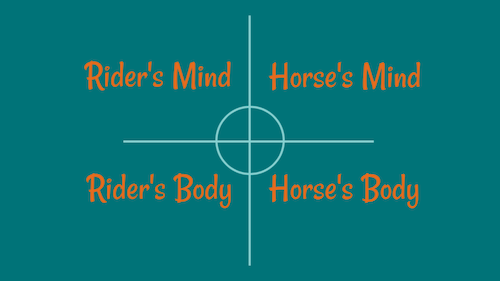
- Blog post on Stacy wrote about the 4 Square model: Quickly Evaluating Problems with Horses and Riders
Subscribe Free
80 Comments
Leave a Comment
SUBSCRIBE TO THE PODCAST HERE:



YOURS FREE
WHY IS MY HORSE...?
This is great. The different stages show up depending which horse I am working with. I do get ‘stuck’ when working the 3 yr old. She has a way of proving my incompetence in certain areas, yet when she responds it also allows the moments of competence in what I am training. 🙂 With the older horse, I tend to go to stage 4 but he also reminds me that I need to back up to stage 3. He keeps me humble.
One of the greatest things about your teaching is that I have become more aware there are others experiencing the same things I do in training so it helps move me past my fear of failure.
Thanks for sharing your knowledge with the added touch of inspiration.
The concept of the 4 stages of competency concepts were so clearly explained that when I am riding I will be able to keep it in mind to help me get unstuck. When you have to break old habits don’t start condemning yourself. Don’t start beating yourself up mentally, because it’s not needed. It’s not helpful. It will hold you back instead of moving you forward. This statement resonated with me.
I was very interested to learn that you are taking dressage lessons. Though dressage is my special interest (and I usually ride “English”) I get a lot out of the things you have to say.
Mary Wanless has a lot to say about the four stages of competence and she brings up a point that is not usually considered. When a riding instructor is living in the land of unconscious competence it is often hard for him/her to access the information a student needs to progress. The student asks “How did you do that?” or “What are you doing?” and the instructor can’t really give the details. The instructor focuses on his/her most recent breakthrough and the student needs information from the time when the instructor had conscience competence of the information in question.
What a great podcast. As usual great and such useful information. This should help alot of people to keep from getting hurt.
Retirement-Finally! A life long dream to ride my horses around the country. My goal is to have safe and reliable trail horses for this endeavor.
Conscious competence leads me to work hard and become aware that trail training can be challenging.
There have been many rides with my seasoned horses riding with unconscious competence.
It would be a dream to master this, but making mistakes is one of the best ways to learn.
My goal from all podcasts is to take something from each one – as we apply and adapt to becoming very competent in each challenge along the way. Competence brings confidence! Thank you! Merry Christmas!
Another great one! Full of great advice, can’t wait for more! Thanks again for doing all of this
Awesome advice! I really love the way you break everything down and also, give examples from your experiences.
Thanks for all that you do to educate the horse community.
Wow! How interesting and very insightful. I feel that we are probably in the stage of conscious competence. Although we may at times fall backwards a bit. I see that we have a lot of work to do to achieve unconscious competence. We have a lot of work to do this summer!
That was so awesome!?
Please keep the podcasts going!
I feel warm and tingly and inspired after listening?
And Anne reminds me of my Mom. You can do it, GO Anne! I don’t know you but I’m soo proud of you!
A great lesson in that we all on the learning continuum and we all start from the same place. You’re so correct that to learn we must go back through the stages to continually add to our knowledge. The riders mind is such a powerful but complex thing that can halt, hinder or progress our horsemanship. These podcasts into the riders mind are amazing and so helpful – thanks Stacy ?
All 5 of these podcasts have been fantastic, Stacy and I’m really looking forward to seeing more of these and more of your Webinars. All 5 have given me a lot to reflect on and “provoking thought” was one of your goals (I believe I saw that in one of your replies) and well… mission successful!
Thank you again for these and doing the giveaway!!!
I feel like I am in the conscious incompetence with my Paso Fino, I show him (at our home shows) in halter class against Quarterhorses… I don’t win, but I do it for the joy of learning and participating.
They added a Gaited class for me, and I learn a lot there too, but I do win (cause we are the only ones in the class!)
Keep it hoof side down!
I love how you break this down and give it words for the different stages. Instead of saying you are “wrong” or “unskilled” you are instead in a learning stage. Thank you so much for what you do and helping me grow and learn.
You say so many things which the world takes for granted. They are simple yet obvious and they make so much sense! There is so much meaning in your podcasts, and we really appreciate the time you take to do this for us… and I’m sure you enjoy it too. You are a thoughtful teacher indeed. merry Christmas!
I haven’t had a lesson in many years. You have inspired me to brush up my skills. Thank you for what you do.
Wow–Did not know their was 4 stages of competency, however it makes sense!! I really want to learn how to do a lead change and I am definitely in the conscious incompetence phase. I had no idea how much goes into such a maneuver. I am thinking about coming out again in 2019, but wondering if I need to get her lope more refined before I do. It is much better but still feels a little out of control on occasions. For instance–when I lope her for the first time she does great! Maybe because she is lazy on the first go around then I may trot for awhile and then ask her again to lope–then she seems to get kinda cranky about it. Not sure what that is all about. I also agree with the advice you gave at the end about finding the right instructor! If you lived closer I would be taking lessons more often for sure. BEST instructor–When I was at your place–there was no negativity, both the horse and rider were not stressed. I felt very comfortable talking with you without being judged, and you took every persons concerns seriously and addressed each one separately.
Hey Stacy! I have realized that I am consciously incompetent about holding my horse accountable and its because I just don’t know what to do at certain times… Can you please do a podcast about this subject where we really go into this? Like for instance, when my horse is jigging on the trail, what do I do as the rider? I don’t mine doing what I should and holding myself accountable, but I don’t know exactly what it best to make my horse be accountable. I do feel I have gotten to certain levels of conscious competence when riding but I am more consciously incompetent and really want to learn the best ways to handle things first, instead of having to go back and having to correct myself. I would be so thankful for your advice!! Keep up the good work Stacy! This is such a generous gift to us all and so much appreciated!!
We learn every day, from everyone … These podcasts were very informative and illuminated the whole range of solutions to possible problems. You always have to learn and never think that you know everything about a horse. It’s a lifelong journey. Thanks!
Excellent!!
I saw Stacy a long time ago on You Tube and was compelled to buy her videos… Love her way with horses and am excited there is no a podcast!!! I subscribed and am eager for each episode. Thank you Stacy!!!! All the way from Australia x
[04:57] Once you enter conscious incompetence, you can start learning and becoming more aware
Good words spoken
When you mention the turning point usually being some kind of injury, it was like a light bulb in my head. So many people chose to find out the hard way that they are in too deep.
Stacy, wow! I listened to all five of your podcast episodes in one day!! I’m really enjoying them! Thank you for sharing your own journey with horses and your humility in admitting struggles you’ve dealt with in your journey. It’s really encouraging! I loved how you encouraged riders not to beat themselves up or condemn themselves when having to break old bad habits. That’s definitely a struggle for me in wanting to “have it all together,” when it comes to riding and training horses. Your encouragement that self condemnation only hinders us and causes us pain was freeing for me. Thank you!
I find it helpful how you break everything down into different stages.
Great information! Thank you!
I remember these four stages from your emails, and they are still good to hear. I think I would consider myself unconsciously competent in most areas, but when fear or nervousness creeps in, I go back to consciously competent and try to control every move. It’s good for me to be put in situations where I just ride and don’t think about it so much at times! Thanks for sharing your wisdom with us.
You are so good at helping us break down our training and knowledge to see where we stand and the steps needed to improve ourselves.
Breaking old habits is the hardest.
I defantly feel like I’m in the middle of 3 and 4. But now after listening to this I feel like there is another side and to keep working through it. Can tell ya how much the’s podcast have helped. Thank you!
I fear I get less patient the older I get. It is helpful to see that I am somewhere around competency level III. A lot of times it feels like I am not getting any better but this makes me feel like I might be moving from different levels of consciousness and not necessarily see it yet.
Thank you! Makes me feel like I am still accomplishing things even though it may not seem like it time after time. I’m somewhere around stage III transitioning into four.
This podcast was a little different for me as i haven’t heard of the levels of competency for horses that is. I believe I am at a level on unconscious competence on some things, consciously competent on a lot, but there are still a lot of things, that I’m consciously incompetent about. And probably more than I realize that I’m still unconsciously incompetent about. But that’s where learning comes in play, we learn new things each and every day about our horses. I am glad i have found a trainer that can help me through my stages. My dream was and still is to go to one of your clinics and take a lesson from you! One day it will happen!
Thanks Stacy for your honesty and frankness, as you too, are on a continual journey of growing. I really appreciate the reminder to find humor vs. criticism when working with my equine partner and also, in daily life.
I’m really enjoying the podcasts! Lots to think about.
This was very interesting. I don’t know a thing about dressage! But now I’m thinking about learning it. These podcasts were all very informative and illuminated a whole range of solutions to possible problems. Thanks!
Thanks for getting into our heads with this. I need to consider some of this more and not take it for granted or just coast. I liked when you mentioned energy and creativity, sad to think we may loose that as we gain competence.
Yes time to stop coasting – for me too great way to say it 🙂
Personally I believe I am at a level on unconscious competence on some things, consciously competent on a lot, but there are still a lot of things, if not most, that I’m consciously incompetent about. And probably more than I realize that I’m still unconsciously incompetent about. Thank goodness for Jesse coming to Asbury to teach us! He is such a blessing and I’ve learned so much from him! He was the first one I heard talk about the level of competencies, and when he did, it’s like a fog was lifted off me as I understood so much more clearly where I am in my horsemanship and learning, and where and how I can improve. These levels on competence can also be applied to horses and their skill levels!
I really appreciated your final comment about, in a sense, holding ourselves accountable for riding with an instructor that can support us wherever we are in our learning stages.
I can see why I am always stuck between 2 and 3…I am always wanting to learn new disciplines and jump around so much I never get to stage 4! The only thing automatic with me is groundwork and mounting! LOL
LOL I hear you there! I’m in same place … but not because of jumping around so much as fear holding me back. Not sure some days if it is fear of failing or fear of succeeding … or fear of fear! Still working that all out. But I have mounting down pat – cause my horse’s fav speed (until we are warmed up) is standing still … and we ALWAYS do groundwork, so we are getting somewhere close to competent.
This is awesome! I can see that these stages can also translate to other areas of my life!
Hi!
I just figured out how to listen to a podcast! So, first time listener.
I have heard of the competency stages from some clinicians I had been following for quite some time. You were right. I looked for help after an injury. It is really helpful to hear different examples and theories on the subject.
Also, podcasts are nice to listen to. I was knitting while listening today.
Thank you!
Elizabeth
I’ve had riding quite explained like this. This is going to make me sit back and evaluate where I am as a rider. Thank you
Is anyone else applying these podcasts to life outside of our horses too?? Stacy you are helping so much more than you’ll ever know by sharing with us. I am feeling empowered & understood. That’s an amazing feeling. You are making me excited about so many things.
Again the biggest take away I have is you’re a safe place to come with questions. Funny part is you’ve helped me see my horses are looking for this type of leadership from me. But so is the rest of the world. Are we providing that kind leadership & do we have mentors to look to?
Thank you for challenging me , leading me & most of all providing a safe environment to grow. Even when it’s clumpsy & we answer the questions wrong. ?
Hi Stacy! Am I wrong to think that a person who THINKS they are at the level of unconscious competence COULD be as dangerous (for lack of a better word) as a person who is at the unconscious incompetence level?
I think I agree with your thinking. The results would be the ‘test’ but yes…I think they could start out in that mind:)
I’ve been incompetent way too long! I love these pod casts they open up a whole new world of horses and I really appreciate it. Not only are you addressing horse issues but mainly riders and too many people blame their horses for their own riding mistake! Great insight!
This is great! It does describe things clearly. I am hovering somewhere between Stage 2 and 3 … with brief moments of Stage 4 (catching, leading, grooming). I read … I listen … I watch … and I try to learn everything I can from every person I see riding. I’m not taking lessons right now … but I do have help from my daughter and her old riding coach. Still working on finding a new riding coach for myself – nobody at barn where we board. But will keep looking and working hard until then.
Stage 4 is where I have been for years but tend to go back to stage 3 when starting new stuff with a horse.
Seeing people that are new to the horse world always make me a little nervous watching them handle their horses. I usually will step in and show them the right way or a better way to do what they are doing and explain what can happen. I do not want to see people get hurt.
I can admit that besides being at stage 4- unconscious competence, I will tend to go back to stage 3-conscious competence which I think everyone does.
oh Lady, I have to listen to this several times, to take it all in. There is a LOT in this episode. my head is spinning.
My thoughts exactly, Jamie. It is deeper than I’ve ever gone before. Stacy is really challenging us!
I think a big part of horsemanship is knowing that you always need to learn and never think you know everything about the horse. It’s a lifelong learning journey
Wow! I hope to not be in stage 1 too much! But stage 2 and 3 are challenges for sure! I do have moments of stage 4 with my first reining horse on our lead changes. They became automatic, almost to the point I barely moved it was almost a mental connection of thinking it! Then I got another horse and it was back to beginning ?